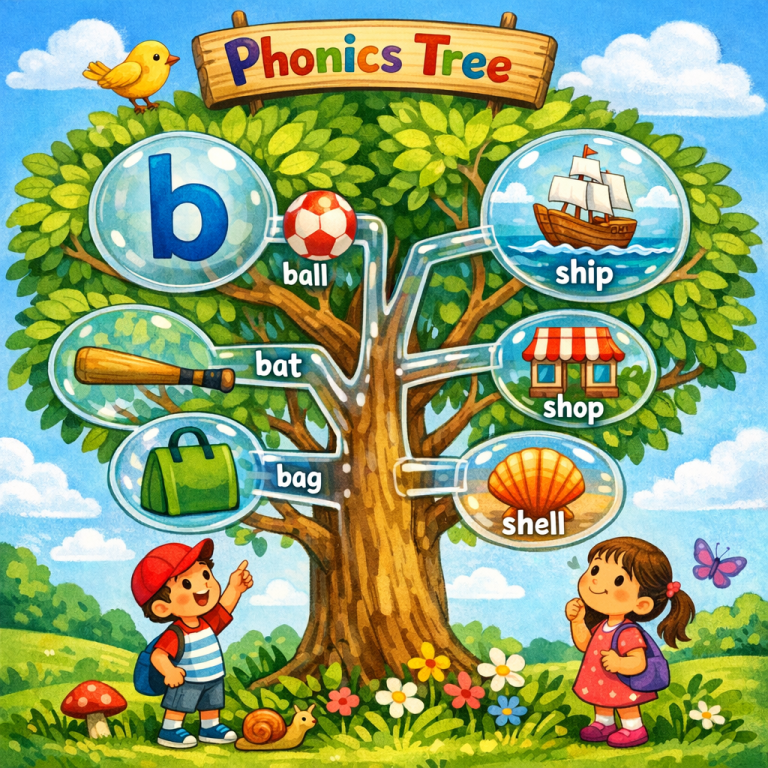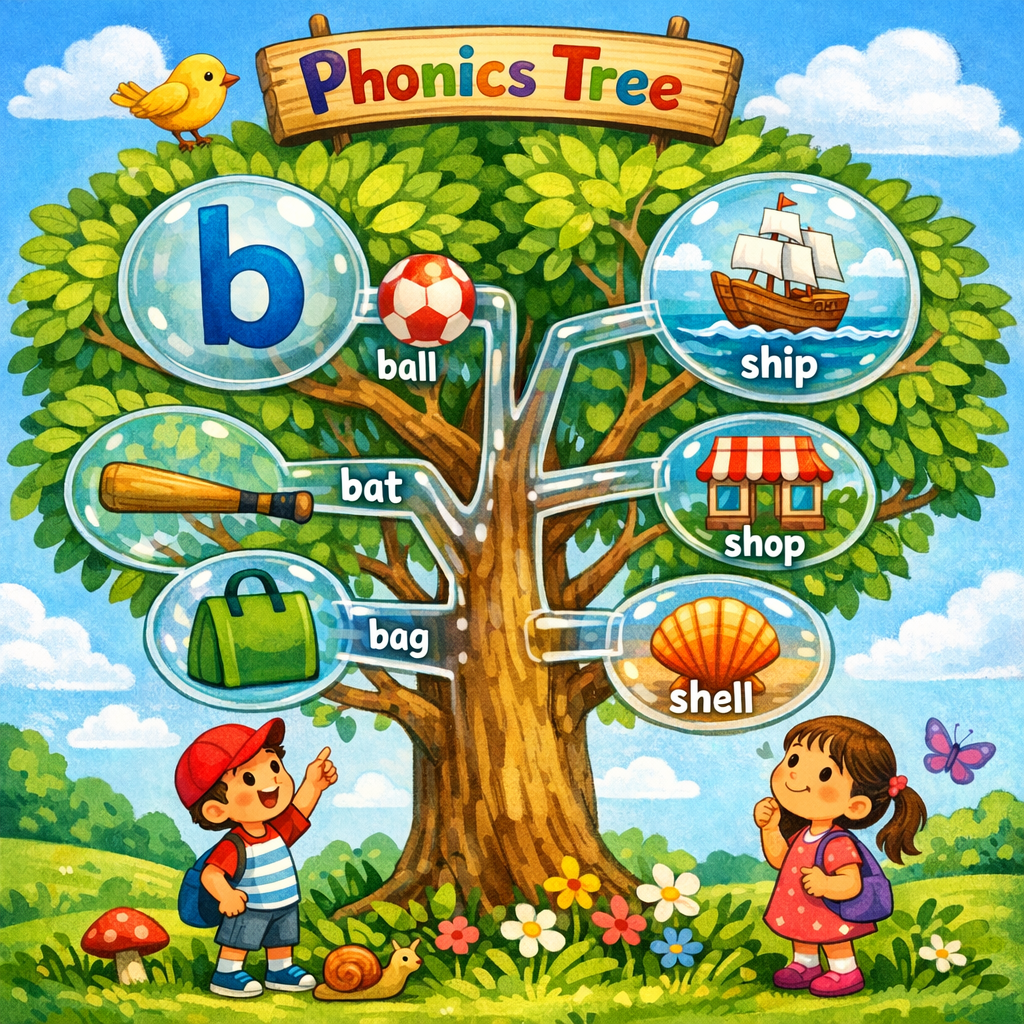
Phonics Tree Activities for Kids ‘Phonics Tree Activities’ are fun and imaginative ways to teach kids letter sounds, words and sound patterns through visual learning. A phonics tree can be used to show letters, word families, rhyming words, blends or other sounds and can make teaching more exciting and easier to learn.
These exercises allow children to join in, to hear sounds and to create words with confidence. The Phonics Tree Activities also increase the level of engagement in the classroom while enabling children to develop their reading, pronunciation, vocabulary and early literacy abilities.
Beginning Sound Phonics Tree
Draw a big tree on chart paper and write one letter sound on the trunk of the tree, e.g., ‘/b/’. Prepare image cards of objects such a ball, bat, banana, bag, bus, and a few photos that begin with sounds other than these. Ask youngsters to choose only those photographs that start with the /b/ sound and glue them on the branches of the tree.
Before placing each word on the tree, have the youngsters recite the word loudly. This game helps youngsters relate sounds to letters, practice listening and identify initial sounds in words they know.
Call or Whatsapp on +918850061389 / +918591021373 for Phonics Class Details!
For downloading the brochure, Click Here!
Word Family Phonics Tree
A word family phonics tree helps youngsters see how similar endings on words can be combined to make various words. Write a frequent Word Family, such as ‘-at’, on the trunk of the tree. Lay out cards with the letters c, b, h, m and r on them. Kids can add one letter at a time before “at” to form words like cat, bat, hat, mat and rat.
Have them read every word aloud as they do each one. Teachers may also add matching illustrations next to the words. This game helps develop blending abilities and word recognition, pronunciation and confidence in reading simple three letter words.
Picture and Sound Matching Tree
Make a phonics tree, with numerous letter sounds on different branches. Give children picture cards of recognizable objects such as apple, fish, sun, dog, cat and mango. Children need to find out what sound each picture starts with and then put the card on the corresponding branch.
For example, a photograph of a fish should be placed on the ‘F’ branch and a picture of a sun should be placed on the ‘S’ branch. Encourage the children to say both the sound and the word. This activity helps with sound awareness, vocabulary, visual identification, and matching spoken words to written letters.
Blending Words Phonics Tree
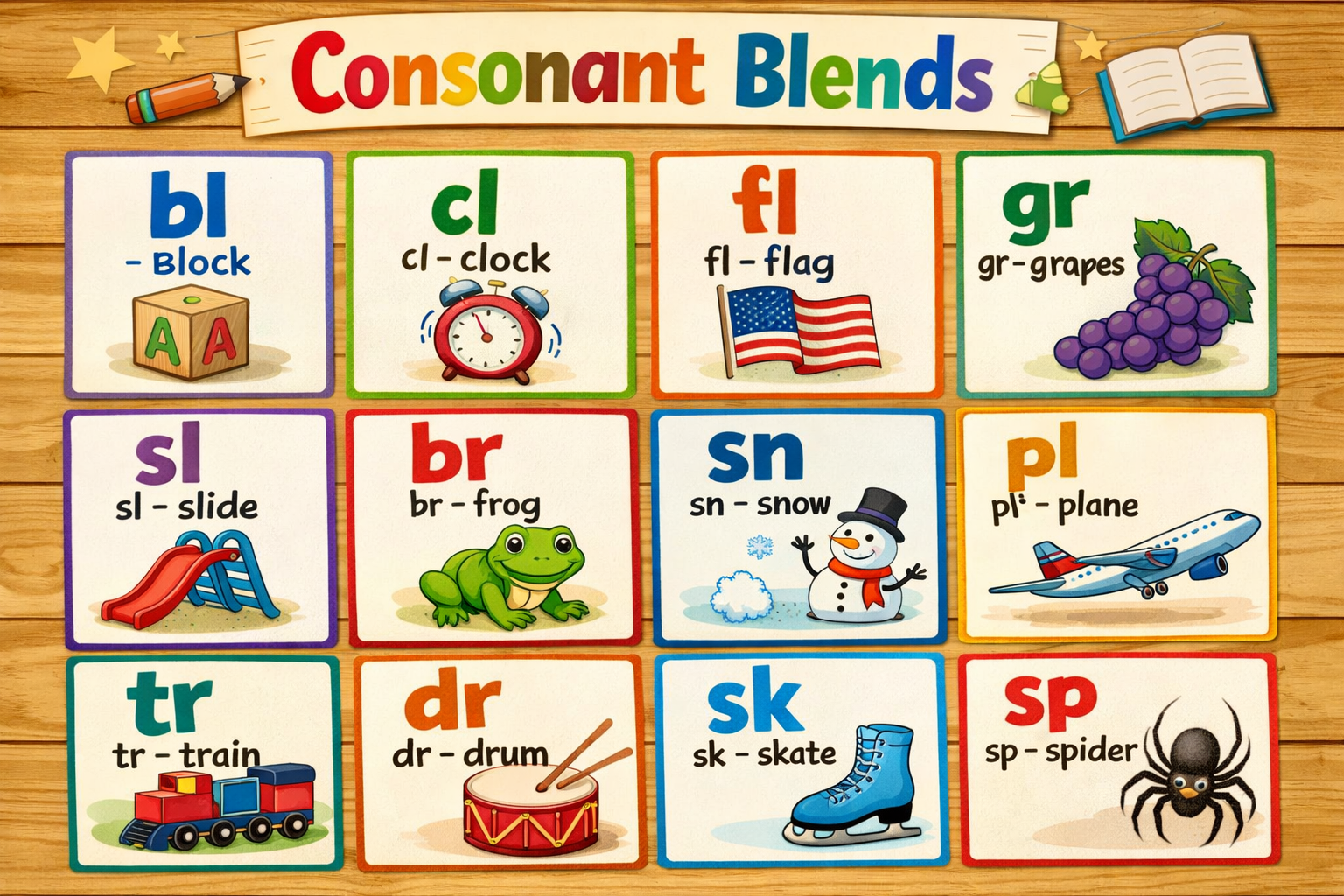
Use the phonics tree to help youngsters practice blending distinct sounds into whole words. On leaves write diverse beginning sounds and on branches common ends such as ‘-at, -in, -og, and -un’. Children can pick out a leaf and match it to a fitting ending. For example, they might blend ‘c + at’ to make cat or ‘s + un’ to make sun.
Have children say each sound in isolation, then combine the sounds gently. Repeating this again and over helps kids learn how separate sounds make whole words. It also supports early reading, decoding, pronunciation and word building skills.
Rhyming Words Phonics Tree
Create a tree that is about rhyming words. Write a simple word on the trunk, like cake. Get leaves ready with words like make, lake, bake, take, dog, sun, and pen. Children can select the phrases that rhyme with cake and arrange them on the branches. Have them say the words out loud and listen for the finishing sounds.
Teachers could repeat the practice using terms such as cat, log, pin or light. Rhyming activities are beneficial for children in understanding sound patterns, phonological awareness, and pronunciation and are helpful in preparing them to be better readers and spellers.
Missing Letter Phonics Tree
For this task, place unfinished words on the branches of the phonics tree e.g. ‘_at, d_g, s_n, p_n,’ and ‘f_sh’. Create letter cards that youngsters can use to complete the words. Let them find the missing sound, choose the right letter and attach it to the word. The youngsters should say each word out loud once it is completed.
Teachers might utilize visuals to give information to young students. This activity reinforces listening, identifying sounds, spelling and forming words. It also teaches youngsters to think critically about the sounds they hear at the beginning, middle, or end of words.
Call or Whatsapp on +918850061389 / +918591021373 for Phonics Class Details!
For downloading the brochure, Click Here!
Vowel Sound Phonics Tree
A vowel sounds phonics tree is a great way to help youngsters practice short vowel sounds ‘a, e, i, o’ and ‘u’. Write each vowel on a different branch and make word or picture cards such as cat, hen, pig, fox and sun. Children will have to listen to the vowel sound that they hear in each word and put the card on the right branch.
Ask them to say the word slowly so they can hear the center sound well. This activity will increase listening abilities, sound discrimination, knowledge of spelling, and reading ability. It’s especially good for children learning simple consonant-vowel-consonant words.
Sight Word and Phonics Tree
A sight word and phonics tree mixes sound practice with common words kids see regularly in their reading. We may view colourful leaves using words such as ‘the, is, can, see, go,’ and ‘we’. Children select a leaf, read the word aloud and use it in a brief phrase. Teachers can also introduce phonetic words like cat, sun, map or hen and ask youngsters to differentiate the sounds.
Children learn to see that certain words are sounded out and others need to be recognized again and over by mixing Sight Words and phonetic words. This activity builds reading fluency, vocabulary, sentence construction and confidence.
Phonics Treasure Tree
Make the phonics tree a fun classroom activity by hiding letter or picture cards around the room. Give the youngsters a target sound, e.g. ‘/m/’ and encourage them to find cards with words that start with that sound. Once they find the cards, they can place them on the phonics tree. Pictures can have moon, mango, monkey, milk, and mouse.
Children identify each picture and say the first sound of the picture before attaching it. It includes movement and phonics, and requires children to be active. It improves sound recognition, vocabulary, memory, attention and listening skills.
Make-a-Word Phonics Tree
For this activity, put different consonants and vowels on removable leaves. Kids can select leaves and place them on branches to spell simple words like cat, dog, pin, bag, and sun. Ask them to say each letter sound, then mix the sounds together. Teachers can give clues or show illustrations if youngsters require help.
As students get better they can make longer words or alter one letter to make a new word, e.g. cat to bat or pin to fin. Phonics Tree Activities practice is a fun method to develop spelling, blending, word construction, pronunciation and early reading skills.
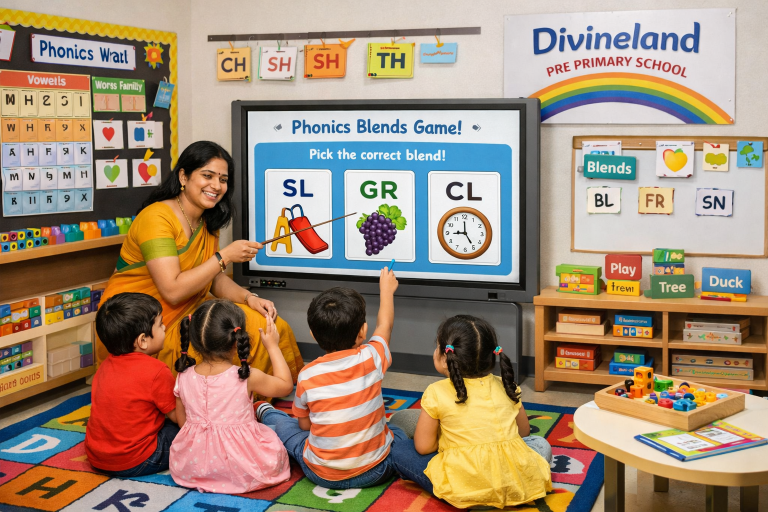
Phonics Tree Activities for Kids make learning sounds fun, easy and memorable. Regular phonics exercise helps youngsters improve their pronunciation, reading, spelling and vocabulary. If you’re a parent looking for a structured phonics learning program for your child, you might want to consider enrolling your child in Divineland’s Phonics Classes where kids learn via fun, age-appropriate activities.
Build reading skills—enrol your child in Divineland’s Phonics Classes today.
Call or Whatsapp on +918850061389 / +918591021373 for Phonics Class Details!
For downloading the brochure, Click Here!
Phonics Tree Activities for Children
FAQs
How do Phonics Tree Activities Help Children Learn?
Phonics Tree Activities assist youngsters in learning to link letters to sounds and words, which enhances sound recognition, vocabulary, and pronunciation and reading skills.
Can Phonics Tree Activities be Used at Home?
Yes. Parents can utilize Phonics Tree Activities at home with paper, cards, images and simple words to make phonics practice fun and simple for kids.