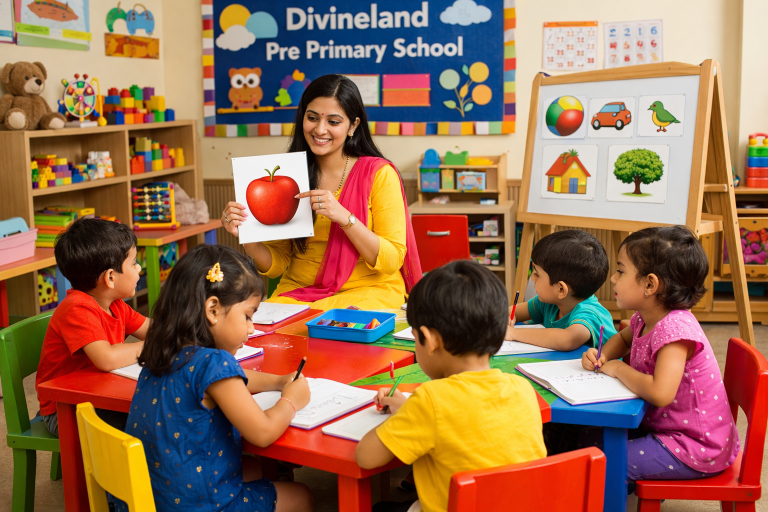
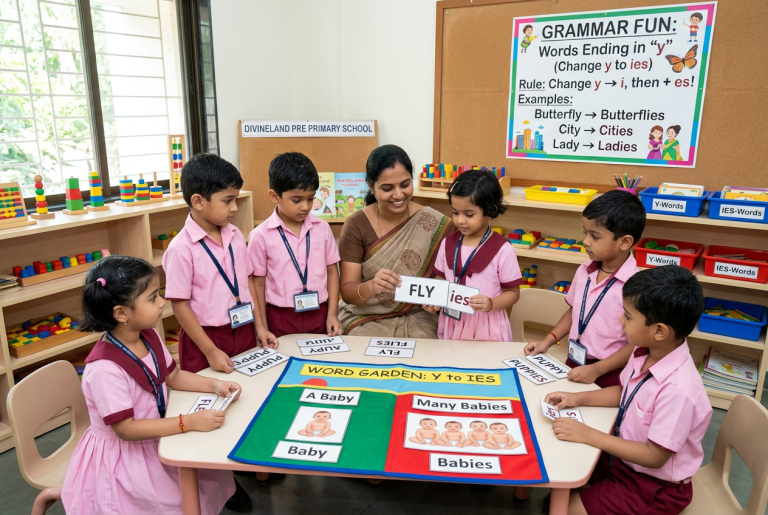
English Grammar Lessons for kids help children to understand how words and sentences are formed correctly. Grammar is the foundation for speaking, reading and writing English with confidence. Children learn grammar through simple examples, games, worksheets and daily conversations and subject becomes easy to understand.
Regular English Grammar Lessons enhance vocabulary, sentence construction, spelling, punctuation and communication abilities while preparing children for further language learning.
Nouns
Nouns are one of the first topics taught in English Grammar Lessons for kids. A noun names a person, animal, place, thing, or idea. They can learn nouns pointing to things around them like teacher, school, dog, table, happiness. Pictures, classroom objects, matching games, naming games can be used by teachers. One way to help children build vocabulary and construct meaningful sentences is to teach them common nouns, proper nouns and collective nouns.
Call or Whatsapp on +919082778593 / +918591021373, for Admission Details!
For downloading the brochure, Click Here!
Pronouns
Pronouns are words used to take the place of a noun so you don’t have to keep repeating the same name. In English Grammar Lessons children learn words like he, she, it, they, we, you and I. For example, instead of saying, “Riya has a book. Children can say, “Riya is reading,” or “Riya has a book. She reads.” Young students find pronouns easier to understand and use correctly through simple sentence exercises and substitution activities.
Verbs
Verbs are words that describe states, actions or events. Common action verbs like run, eat, write, sing, jump and sleep are easy for children to understand. Learning can be made interesting for children by teachers asking them to do different actions and name them. The children can then use these verbs in sentences. Verbs are practiced regularly to help kids understand what a person, animal, or object is doing in a sentence.
Adjectives
Adjectives are describing words that provide more information about nouns. English Grammar Lessons on adjectives can teach children words related to colour, size, shape, number, appearance, and feelings. For example, children can describe a ball as red, round, small, or soft. Activities such as describing classroom objects, pictures, animals, and people encourage children to use adjectives naturally. Learning adjectives helps children make their sentences more interesting, detailed, and expressive.

Articles
Articles are little words that come before nouns. The three main articles are “a,” “an” and “the.” In English Grammar Lessons children can be taught that “a” is used generally before consonant sounds, and “an” is used before vowel sounds. The” refers to a specific thing. It is easier with concepts such as “a cat,” “an apple,” and “the sun”. Fill in the blank exercises are good for children to practice selecting the correct article in various sentences.
Prepositions
Prepositions indicate the position, place, direction or relationship of one thing to another. English Grammar Lessons teach common prepositions like in, on, under, behind, near, between, beside, and above. These words can be demonstrated by teachers with objects in the classroom. E.g., “The pencil is on the table” or “The bag is under the chair.” Practical activities help to remember the prepositions easily and help the children to build grammatically and meaningfully correct sentences.
Conjunctions
Conjunctions are joining words. They join words, phrases or sentences. Examples include and, but, because, or, and so. English Grammar Lessons introduce conjunctions, using short, familiar sentences. “Riya likes apples and bananas” or “I stayed home because it was raining. Sentence-completion exercises can help kids see how words connect. Once children learn conjunctions they can more easily link their thoughts together and produce longer clearer sentences when speaking and writing.
Call or Whatsapp on +919082778593 / +918591021373, for Admission Details!
For downloading the brochure, Click Here!
Tenses
Tenses help children to understand when an action takes place. English Grammar Lessons teach children about present, past and future actions. For example, “I play” is present tense, “I played” is past tense and “I will play” is future tense. Teachers should start with the simple forms of tenses and then move to the more advanced forms. Timeline activities, conversation and sentence writing can make tenses easier for children to understand and help them to tell about events accurately.
Singular and Plural Words
Singular words are for one person, animal, place or thing. Plural words are for more than one. In English Grammar Lessons children are given examples like book-books, toy-toys, child-children, foot-feet. Teachers can begin with the regular plurals and then introduce the irregular forms. This notion can be reinforced by picture exercises, sorting activities and sentence practice. Knowing the singular and plural forms helps children to speak and write sentences with the right words.
Sentence Formation
One of the most important parts of English Grammar Lessons is to learn how to form sentences. Kids are taught that a basic sentence usually needs a subject and a verb. For example Birds fly or the girl sings. They can begin to add description and other details to extend their sentences. Word arrangement games, picture descriptions and sentence building cards help children to understand the correct word order and encourage them to clearly express their ideas in English.

Punctuation
Punctuation is important for readers to grasp the meaning and tone of sentences in writing. English Grammar Lessons for kids should introduce basic punctuation marks such as full stops, commas, question marks, exclamation marks and apostrophes. Kids can practice identifying the beginning and end of sentences, and they can learn how and when to use different punctuation marks. Short sentences editing worksheets and punctuation are good practice. Proper punctuation makes children’s writing clearer, easier to read and more organized.
Capital Letters
Another basic topic covered in English Grammar Lessons for young students is Capitalization. Children should be taught that sentences start with a capital letter, and that the names of people, places, days of the week, months of the year and some special words need capital letters. Examples Monday, India, Rohan and January make it easy to understand the rule. Spot-the-error games and rewriting exercises can help children develop better writing habits and practice capitalization from an early age.
English Grammar Lessons for Kids help children build a strong foundation in speaking, reading, writing and sentence formation from an early age. Teaching grammar with simple activities, stories and interaction with the class helps children learn with more confidence. Divineland Pre Primary School is a good choice if you are a parent looking for a nurturing preschool environment. They provide age-appropriate learning that fosters language development and overall growth. Enroll your child today for a great start in early education.
Enroll your child at Divineland Pre Primary School for strong English skills!
Call or Whatsapp on +919082778593 / +918591021373, for Admission Details!
For downloading the brochure, Click Here!
FAQs
What Grammar Topics should Kids Learn First?
Kids can start learning about nouns, pronouns, verbs, adjectives, articles, prepositions, punctuation and forming simple sentences.
How can English Grammar Lessons be Made Interesting?
Grammar can be fun through stories, games, picture activities, worksheets, role play and simple examples from everyday life.