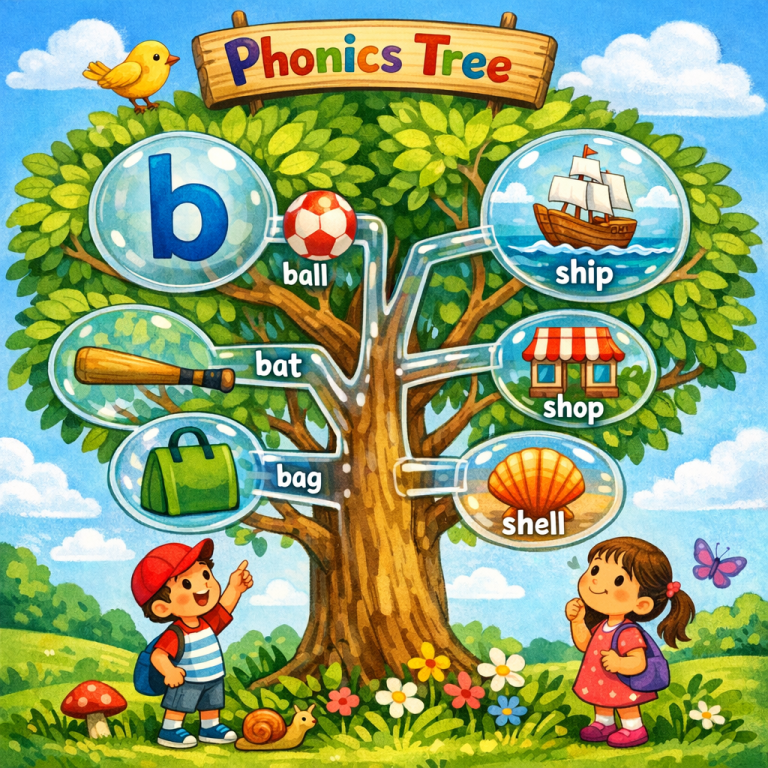
Phonics Rules help children learn how letters make sounds and how those sounds come together to form words. Understanding Phonics Rules makes reading easier because children can decode new words step by step. When kids practice Phonics Rules regularly, they start recognizing patterns in words and improve their reading confidence.
Phonics Rules also support better spelling skills as children learn how sounds match with letters. Learning Phonics Rules at an early stage builds a strong foundation for reading fluency and language development.
Short Vowel Sounds
One of the foundational phonics rules is the recognition of short vowel sounds. Vowels (a, e, i, o, u) typically have a short sound when they appear alone in a syllable or word. ‘A’ in “cat”, ‘e’ in “bed”, ‘i’ in “sit”, ‘o’ in “top”, and ‘u’ in “bug” are a few examples of small sounds. For young learners, understanding these sounds is essential since they serve as the basis for many simple spellings.
For Admission Details, Call or Whatsapp on +918850061389 / +918591021373!
Click Here, for downloading the brochure!
Long Vowel Sounds
Little vowels contrast with big vowels, which sound like their names. This phonological rule is evident in spellings such as “cake” (where the ‘a’ sounds like ‘ay’), “tree” (where the ‘e’ sounds like ‘ee’), “bike” (where the ‘i’ sounds like ‘igh’), “boat” (where the ‘o’ sounds like ‘o’), and “cube” (where the ‘u’ sounds like ‘you’). Different English spellings can be spoken more easily when one knows the distinction between short and long vowel sounds.
Silent ‘e’
The silent ‘e’ phonics rule is fascinating. It modifies the articulation of a spelling by creating the preceding vowel into a long sound, while the ‘e’ itself remains silent. For instance, in “bit” and “bite”, the ‘e’ at the end of “bite” creates the ‘i i’ a long sound. This rule is predominant in English and is an important concept for students to recognize.
Consonant Blends
Consonant blends include more than two consonants combined, with every retentive its sound when spelled. Instances contain ‘bl’ in “black”, ‘cr’ in “crisp”, and ‘st’ in “stop”. These blends are essential for developing reading skills, as they appear frequently in English words.
Digraphs
Digraphs are pairs of letters that make one sound. Phonics rules related to digraphs are crucial as they may be whichever vowel digraphs (like ‘ea’ in “bread”) or consonant digraphs (like ‘ch’ in “cherry”). Comprehending digraphs is significant for deciphering many English words.

R-Controlled Vowels
At this point of the phonics rule, when a vowel is shadowed by an ‘r’, it makes all the more a different sound. Instances involve ‘ar’ in “car”, ‘er’ in “her”, ‘ir’ in “bird”, ‘or’ in “corn”, and ‘ur’ in “turn”. The above r-controlled vowels are important in unique word sounds and meanings.
Diphthongs
Diphthongs are difficult vowel sounds shaped by the grouping of two vowels in one syllable. The sound starts as a single vowel and shifts near the other, like ‘oi’ in “boil” or ‘ou’ in “cloud”. Phonics rules for diphthongs are vital for fluent reading and correct pronunciation.
CVC Words in Phonics Rules
The CVC (consonant-vowel-consonant) rule is a pattern where a short vowel sound is sandwiched between two consonants, like “cat”, “dog”, and “bug”. This simple structure is a key teaching tool in early phonics education.
Magic ‘y’
The ‘magic y’ phonics rule indicates that when a spelling finishes in ‘y’, and there is only a single consonant before ‘y’, the ‘y’ modifies the short vowel into a long vowel. For example, “cry” turns from a short ‘i’ sound in “crib” to a long ‘i’ sound.
Soft ‘c’ and ‘g’
Lastly, the phonics rule for soft ‘c’ and ‘g’ comes into the picture when the following consonants are shadowed by ‘e’, ‘i’, or ‘y’. The ‘c’ in “cent” and the ‘g’ in “giraffe” are spelled softly, not like their hard sounds as in “cat” or “go”.
To read and write well, you need to know these phonics rules. Not only do they help students figure out how to read words, but they also give them a strong base for language skills. Phonics is an important part of literacy education that gives students the skills they need to communicate well.

Phonics Classes for Kids
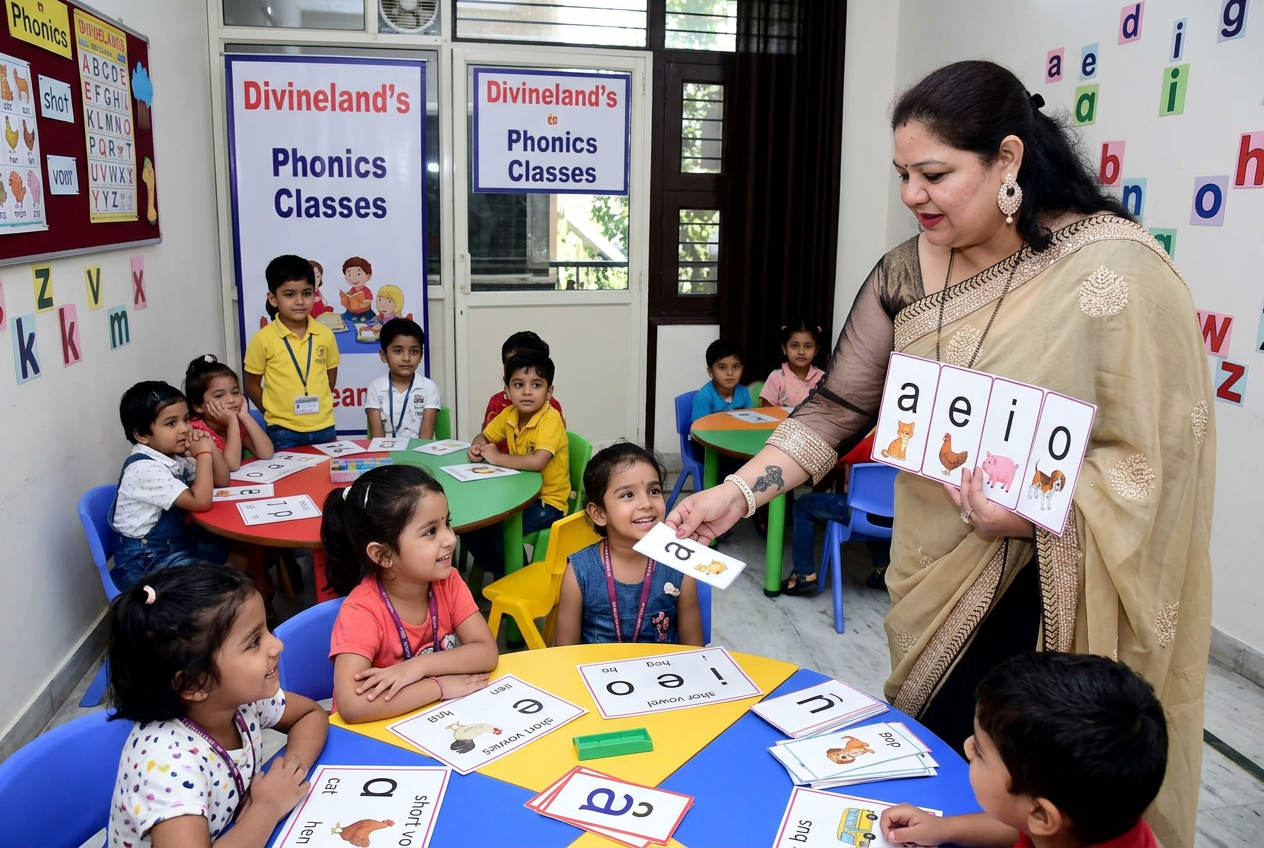
Kids’ phonics classes are very crucial for helping them learn to read and speak correctly. Divineland’s Phonics Classes teach kids about sounds, letters, and how to make words in a structured way. These Phonics Rules make it fun and easy for kids to learn how to read.
Kids who know Phonics Rules well can easily tell what letter sounds. When kids practice Phonics Rules every day, they get better at speaking and reading new words. Divineland makes sure that every child learns Phonics Rules in a fun and interesting way that keeps them interested.
Divineland’s Phonics Classes use fun activities and repetition to help kids learn and remember the rules of phonics. Teachers make sure that Phonics Rules are clear so that students can follow them step by step.
Some things that make Divineland’s phonics classes special are:
- Learning through sound that is fun and helps you remember Phonics Rules
- Storytelling workshops to put Phonics Rules into practice when reading
- Flashcards and other visual aids to help you grasp Phonics Rules better
- Games and rhymes that naturally help kids remember Phonics Rules
- Giving each child one-on-one attention to make sure they learn Phonics Rules well
These things help kids connect sounds to words and develop good reading habits. Divineland’s regular Practice of Phonics Rules makes learning to read and write easier and more fun.
Divineland’s Phonics Classes focus on creativity and building confidence in students. Children who are regularly exposed to Phonics Rules learn a lot about language that will help them do well in school in the future. The systematic way that Phonics Rules are taught makes sure that each kid learns at their own rate and has fun doing it.
Join Divineland’s Phonics Classes for strong reading foundation today!
For Admission Details, Call or Whatsapp on +918850061389 / +918591021373!
Click Here, for downloading the brochure!
FAQs
Why are Phonics Rules Important?
Phonics rules help kids build strong reading skills, improve their pronunciation, and decode new words with confidence, which helps with early literacy and language development.
Does Divineland Offer Phonics Classes?
Yes, Divineland's Phonics Classes focus on interactive learning, helping kids master phonics rules through fun activities, sounds, and guided reading practice.